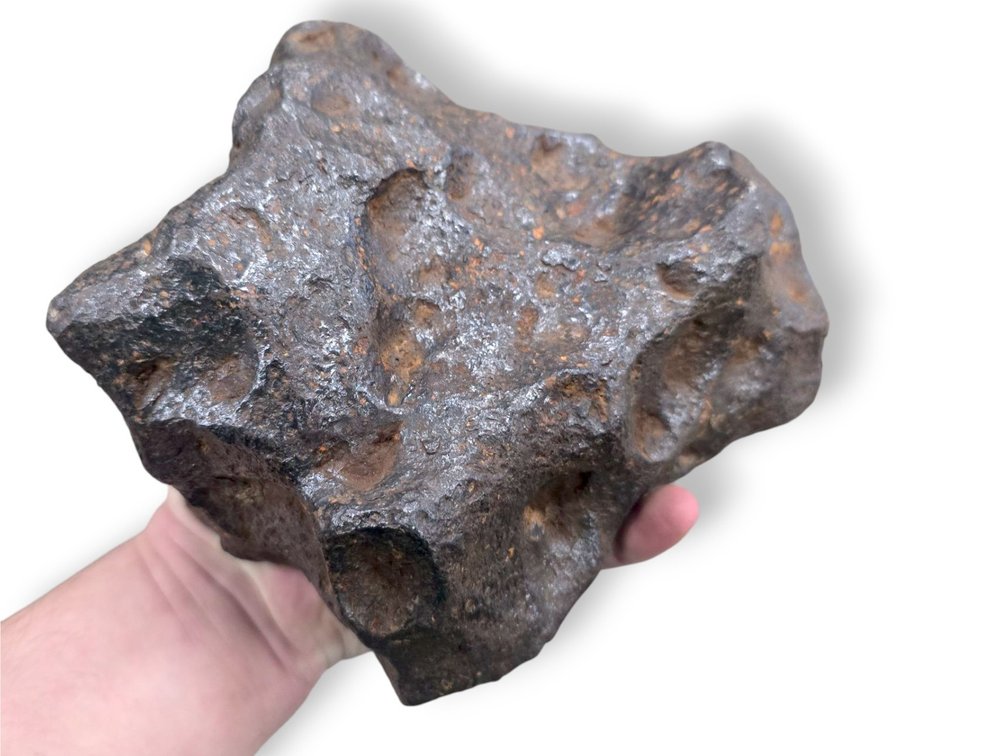
#54 • 10.46kg Campo del Cielo Iron Meteorite
Part of June 2025 Premier Auction (live auction by Alaska Premier Auctions & Appraisals)
High bid $4,600.00
Status: Sold
Category: Natural History
A compact iron-nickel meteorite specimen featuring a dense, irregular form with numerous shallow depressions known as regmaglypts or "thumb prints," which are characteristic of atmospheric ablation. The friction and stress caused during atmospheric passage caused the much larger specimen to break up into smaller pieces, and the larger masses collided with Earth at sufficient velocity to create over two dozen sizeable impact craters; this all happening posts-cataclysmic collision between two asteroids in outer space over 4,000 years ago. The Campo de Cielo, meaning "Field of Heaven," meteorite was first discovered and recorded, historically, c.1576 in Chaco, Argentina (roughly 620 miles from Buenos Aires) by Spanish explorers, at at time when when little was known about its origin. Subsequent studies have dated the meteorite to be 4.5 billion years old, with it have likely formed as part of the development of the Solar System itself. Additionally, the average composition of Campo del Cielo meteorites is 92.6% iron, 6.67% nickel, and the remainder small percentages of iridium, gallium, germanium, phosphorus, and cobalt. Measures approximately 8" x 6.5" x 4".