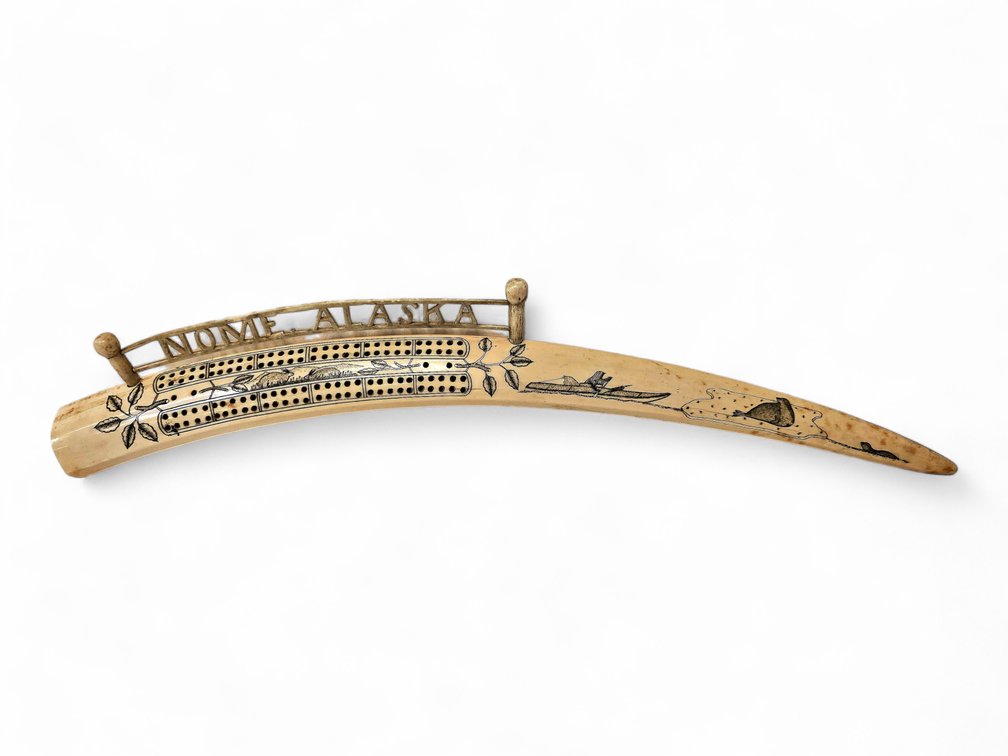
#37 • A Nome Gold Rush Era Cribbage Board by Happy Jack
Part of March 2026 Premier Auction (live auction by Alaska Premier Auctions & Appraisals)
High bid $5,500.00
Status: SOLD
Category: Ethnographic Objects
An important early 20th-century cribbage board, attributed to the renowned Inupiaq artist "Happy Jack" Angokwazhuk (1870?-1918). "Happy Jack" Angokwazhuk is widely regarded as one of the earliest professional Native Alaskan ivory carvers. The tusk is crowned with a charming carved "Nome, Alaska" gateway sign, evoking the energy and optimism of the Gold Rush era in which Angokwazhuk found his audience. The playing surface comes alive with a delicately rendered scrimshaw scene of snow hares nestled among flowing foliate designs, while the surrounding imagery unfolds like a story of the Arctic—an Alaska Native hunter gliding by kayak in pursuit of a seal, whales moving through open water, a lone caribou in quiet profile, and, on the underside, a striking vignette of a polar bear and walrus sharing an ice floe. Together, the scenes create a vivid and engaging narrative, blending traditional life with the artist’s distinctive vision for objects made to captivate both use and display. Angokwazhuk (known as "Happy Jack" for his affable nature) rose to prominence in the late 19th century after overcoming severe physical hardship, ultimately becoming a central figure in the evolution of Bering Strait ivory carving for a commercial audience. His work is noted for its narrative quality, technical precision, and incorporation of cross-cultural themes, and he is frequently cited as the first professional Alaskan Eskimo artist. Attribution is based on stylistic and thematic consistency, of which elements are identical to institutionally held Angokwazhuk examples. The board measures approximately 21" x 2.5" x 4.25" tall.