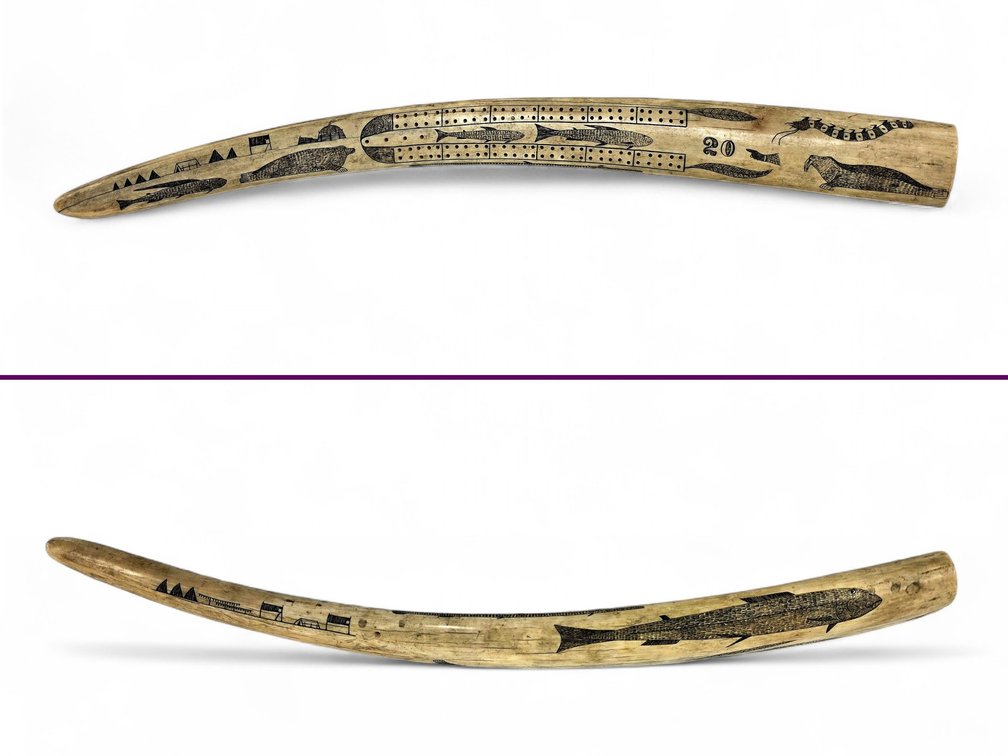
#46 • Happy Jack Angokwazhuk Attributed Nome Gold Rush Scrimshaw Cribbage Board
Part of June 2026 Premier Auction (live auction by Alaska Premier Auctions & Appraisals)
High bid $2,800.00
Status: Sold
Category: Ethnographic Objects
An exceptional and highly elaborate scrimshawed walrus tusk cribbage board attributed to celebrated Inupiaq artist "Happy Jack" Angokwazhuk (1870?-1918), among the earliest and most influential professional Alaska Native ivory carvers. Created during the height of the Nome Gold Rush era, the large tusk transforms a practical gaming object into a richly narrative work of Arctic folk art, displaying the whimsical imagery, flowing composition, and decorative foliate devices for which Angokwazhuk's finest work is renowned. The upper surface is organized around a fully functional cribbage board bordered by intricately engraved scenes depicting fish, seals, a walrus, and a Native encampment complete with tents and dwellings. The broad terminal end features a particularly charming and animated walrus accompanied by an extraordinarily unusual caterpillar figure with segmented body and articulated legs, one of the fanciful and almost storybook elements occasionally encountered in Happy Jack's most imaginative compositions. Flowing foliate devices and curvilinear forms animate the surrounding scenes, lending the piece a distinctive sense of movement and personality. The reverse side continues the visual narrative with additional fish and camp scenes with implements and supplies hung out to dry, while one side depicts a kayak hunter approaching a pair of walruses with harpoon in hand. Together, the imagery reads almost as an illustrated chronicle of Bering Strait life, infused with the artist's characteristic humor and decorative sensibility. Known affectionately as "Happy Jack" for his cheerful disposition, Angokwazhuk overcame severe physical disability to become a central figure in the emergence of Bering Strait ivory carving for a commercial audience. His work is celebrated for its technical precision, narrative quality, and unique blending of traditional subsistence imagery with decorative motifs intended to captivate the miners, traders, and visitors arriving during the Gold Rush era. Today he is widely regarded as the first professional Alaska Native artist, with examples preserved in major museum collections. Attribution of the present piece is based upon strong stylistic and thematic consistency with documented examples, particularly the narrative organization, whimsical embellishments, flowing foliage, and animated treatment of Arctic animals. The present cribbage board descended through the family of Nome merchant John Louis Beau, who spent approximately thirteen years in Nome during the Gold Rush period operating the Beau Mercantile. Following the death of his wife in 1895, his children, Della and Johnny, were raised by relatives in Wisconsin while Beau continued his pursuits in Alaska. In 1933, his daughter Della recovered the remaining contents of her father's bankrupt estate, preserving a small group of Alaskan photographs and artifacts that remained in the family for generations. The collection ultimately descended to Father Edward F. Sippel of Fond du Lac, Wisconsin. Notably, another scrimshaw object from the same family group incorporates imagery derived from a February 1904 photograph depicting Beau with his children, providing compelling context linking the collection to Nome's formative Gold Rush years. The tusk retains its original closed end. A peg hole is present on the underside, though the leveling peg is absent. Measures approximately 22.5" x 2" x 1.25" tall. Provenance: Private Collection, Anchorage, AK Collection of Father Edward F. Sippel of Fond du Lac, Wisconsin, inherited from his mother, Della (Beau) Sippel, daughter of John Louis Beau