#51 • Exceptional Happy Jack Angokwazhuk Scrimshaw Walrus Tusk Cribbage Board
Part of June 2026 Premier Auction (live auction by Alaska Premier Auctions & Appraisals)
High bid $1,900.00
Status: Sold
Category: Ethnographic Objects
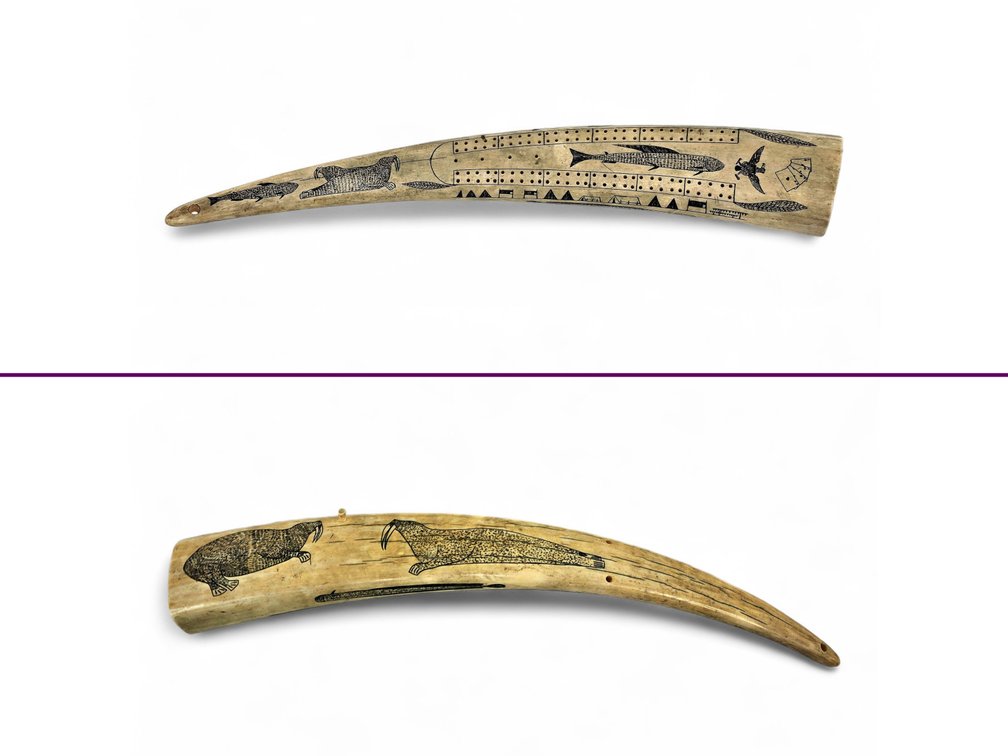
An exceptional scrimshawed walrus tusk cribbage board attributed to celebrated Inupiaq artist "Happy Jack" Angokwazhuk (1870?-1918), among the earliest and most influential professional Alaska Native ivory carvers. Executed during the Nome Gold Rush era, the tusk displays many of the artistic hallmarks associated with Angokwazhuk's finest work, combining practical function with lively narrative scenes, whimsical creatures, and decorative embellishments intended to delight both use and display. The upper surface is centered by an elongated pegging track surrounded by finely engraved imagery including large fish, walruses, a heraldic eagle with spread wings, a Native village with dwellings, and an unusual hand of four playing cards. Flowing foliate devices and curvilinear forms weave throughout the composition, imparting movement and a distinctly playful quality. Particularly appealing are the stylized and somewhat whimsical animals, rendered with expressive forms and delicate stippling that lend the piece an almost storybook character. The underside presents a pair of walruses with additional marine imagery extending onto the sides, while the overall composition demonstrates the artist's characteristic ability to transform an everyday object into a richly illustrated chronicle of Arctic life. Known affectionately as "Happy Jack" for his cheerful disposition, Angokwazhuk overcame severe physical hardship to become a central figure in the development of Bering Strait ivory carving for a commercial audience. His work is celebrated for its narrative quality, technical precision, and distinctive blending of traditional Indigenous subject matter with decorative motifs intended to appeal to the miners, traders, and visitors who flooded Nome during the Gold Rush. Today, he is widely regarded as the first professional Alaska Native artist. Attribution of the present piece is based upon strong stylistic and thematic consistency with documented examples, particularly the animated treatment of animals, heraldic imagery, flowing foliate motifs, and whimsical decorative vocabulary. Like the accompanying example from the same family group, this cribbage board descended through the family of Nome merchant John Louis Beau, who operated the Beau Mercantile during Alaska's Gold Rush era. Following his death, his daughter Della preserved a small group of Alaskan artifacts and photographs recovered from his estate in 1933, which subsequently descended to Father Edward F. Sippel of Fond du Lac, Wisconsin. The narrow end is pierced for suspension by a leather thong, suggesting it was intended to be carried or displayed. Three drilled holes at the center provided leveling capability, though two leveling pegs are absent as photographed. The open broad end reveals the natural interior of the tusk with secondary dentine visible. Measures approximately 18" x 2.75" x 1.75" tall. Provenance: Private Collection, Anchorage, AK Collection of Father Edward F. Sippel of Fond du Lac, Wisconsin, inherited from his mother, Della (Beau) Sippel, daughter of John Louis Beau