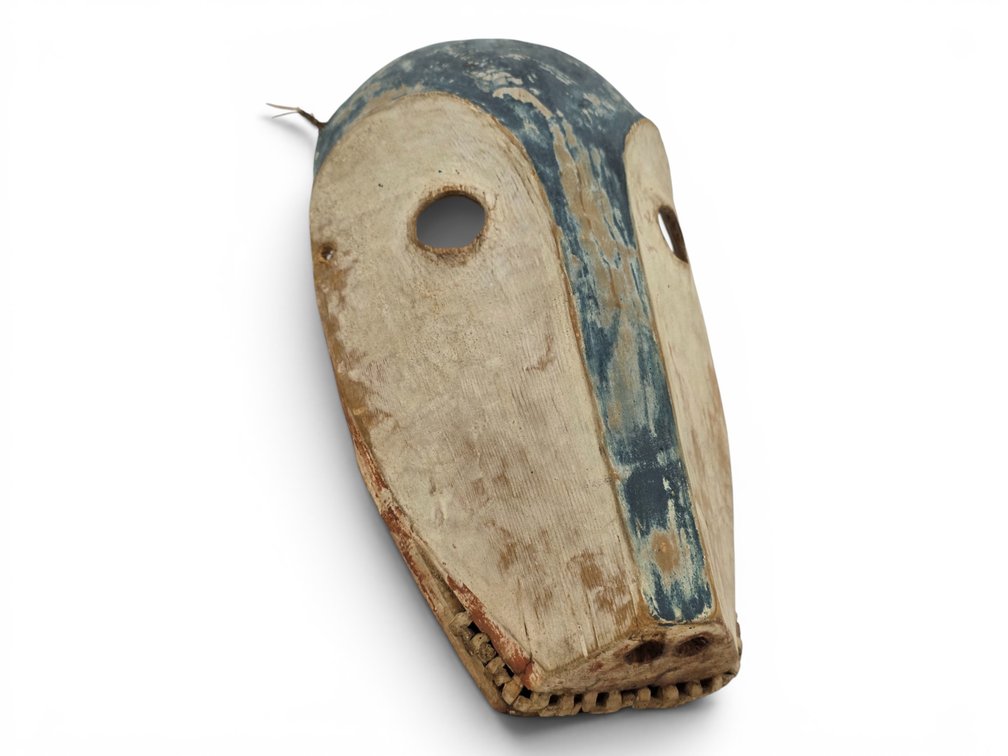
#53 • Important Late 19th C. Yup'ik Animal Spirit Mask
Part of June 2026 Premier Auction (live auction by Alaska Premier Auctions & Appraisals)
High bid $8,750.00
Status: Sold
A finely sculpted late nineteenth-century Yup'ik animal spirit mask, likely representing a wolf, from western Alaska and stylistically consistent with masks attributed to the St. Michael / Lower Yukon–Norton Sound region. Carved circa 1875~ from wood with surviving blue, white, and red pigment and measuring 5.5 inches wide by 2 inches deep by 9.25 inches high, the present work belongs to a long-established Yup'ik carving tradition whose surviving examples rank among the most recognizable and historically significant artistic expressions of Alaska Native art. Within Yup'ik communities, masks served as active participants in ceremony, dance, storytelling, remembrance, and the expression of relationships between the human, animal, and spirit worlds. Rather than existing as permanent works of art, they were created to be animated through song and movement, giving visual form to ideas, memories, and spiritual relationships central to community life. Their intended use, together with the fragile nature of their materials, accounts for the comparatively small number of pre-20th-century examples preserved today. The present mask is organized with exceptional assurance. A broad, rounded crown resolves into an elongated projecting muzzle structured by a continuous blue field framed by expansive white facial planes, while large elliptical eye openings, paired drilled nostrils, restrained red accents, and an articulated jaw retaining individually carved and pegged wooden teeth create a composition that is simultaneously abstract and vividly animate. Two original feather-quill remnants remain preserved at their attachment points, accompanied by additional vacant holes that once held a more elaborate feather arrangement completing the mask's ceremonial presentation. Particularly close parallels may be drawn with a small corpus of documented nineteenth-century western Alaska masks preserved in major museum collections. The closest published comparison is the Yup'ik wolf mask collected at St. Michael, Alaska, now in the Sheldon Jackson Museum, which shares the elongated projecting muzzle, uninterrupted blue median stripe, expansive white facial organization, paired drilled nostrils, articulated lower jaw, individually pegged wooden dentition, and feather attachment system present here. Closely related characteristics recur in the Yup'ik Wolf Spirit Mask in the Museum of Fine Arts, Houston, dated 1850–1875; an animal-form mask collected in Alaska in 1891 and now preserved in the Dallas Museum of Art; and a comparable example associated with St. Michael / Port Clarence material collected during 1892–1893 and now held in the Sainsbury Centre. Considered together, these independently collected works provide strong context for the present mask and demonstrate the recurrence of a distinctive western Alaska aesthetic marked by elongated zoomorphic form, disciplined painted geometry, articulated construction, and refined restraint. The reverse retains a rich interior patina together with a vintage Sotheby's auction hanging tag bearing blue lot number "98," as well as a stenciled designation "AA 14" and a fragmentary earlier paper inventory label appearing to end in "...414." Distinct from the Sotheby's tag, the latter markings are characteristic of historic institutional cataloging systems or advanced early private collections, documenting multiple stages in the mask's collecting history. While they have not been conclusively linked to a published collection, they provide tangible evidence of long-standing appreciation and careful stewardship prior to its appearance on the contemporary market. The enduring appeal of Yup'ik masks lies in their ability to unite sculpture, ceremony, and belief within a single object, preserving cultural knowledge and artistic expression in forms of remarkable clarity and lasting resonance. More than a century after its creation, the present mask remains an eloquent expression of that tradition, its sculptural vitality and refined execution continuing to command the same visual authority that first distinguished it. Equally at home in distinguished private collections and institutional holdings, it represents an increasingly uncommon opportunity to acquire an important work of nineteenth-century Alaska Native art.