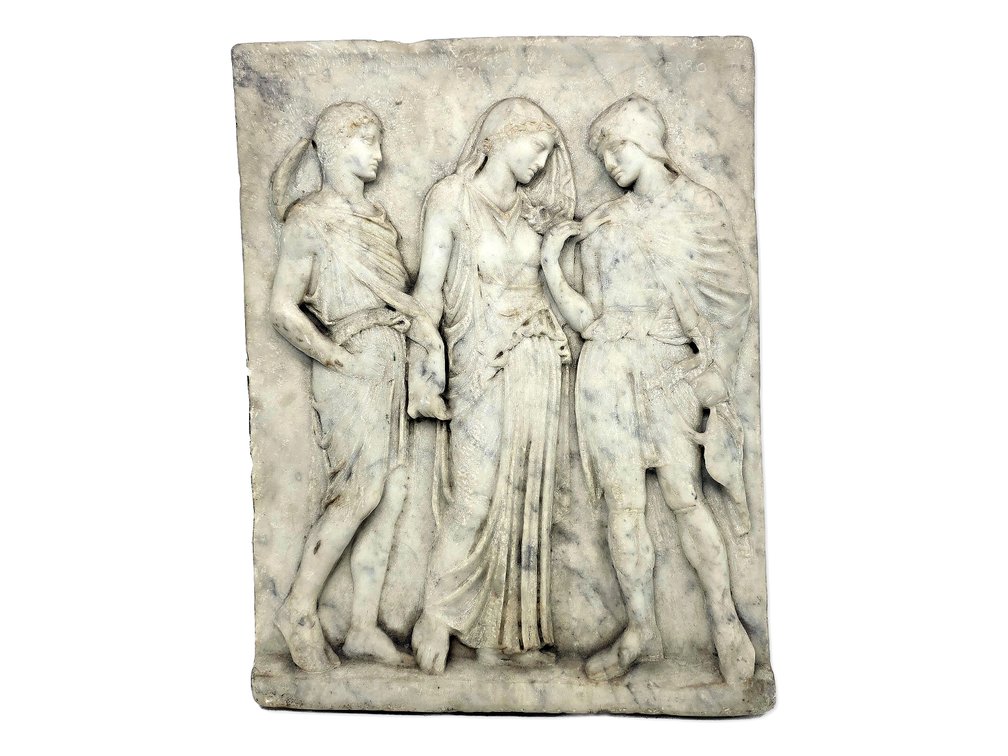
#93 • 19th C. Italian Grand Tour Marble Orpheus, Eurydice & Hermes Relief
Part of Fall 2026 Premier Auction (live auction by Alaska Premier Auctions & Appraisals)
High bid $2,100.00
Status: Sold
Category: Art
A substantial 19th-century Italian Grand Tour relief, hand-carved from a single slab of white marble and depicting Orpheus, Eurydice, and Hermes at the moment of the couple's final separation. Based upon one of the most celebrated three-figure compositions surviving from Classical antiquity, the relief arranges Hermes at left, Eurydice at center, and Orpheus at right, their restrained poses and interlocking gestures conveying the quiet pathos of the scene. Hermes, messenger of the gods and psychopompos, or guide of souls to the Underworld, appears in profile wearing a short chiton and traveler's cloak, or chlamys, with his broad-brimmed petasos suspended behind his head. He gently takes Eurydice by the wrist, preparing to lead her away. The veiled Eurydice wears a long, deeply pleated peplos and turns toward her husband, resting one hand upon his shoulder. Orpheus meets her gaze and touches her hand while carrying his lyre at his side. His peaked Thracian cap, short chiton, cloak, boots, and musical instrument identify the legendary poet and musician. The composition is traditionally understood to represent the tragic conclusion of the myth of Orpheus and Eurydice. Following Eurydice's death, Orpheus descended into the Underworld and persuaded Hades to permit her return to the living, provided that he did not look back at her during their ascent. Unable to resist, Orpheus turned toward his wife before they had reached the upper world, condemning Eurydice to return to the realm of the dead. Hermes appears to reclaim her as the couple exchanges a final, tender farewell. The scene derives from a celebrated Greek prototype created during the late 5th century BCE and preserved through several ancient marble repetitions. The best-known version is the Roman relief in the Museo Archeologico Nazionale di Napoli, inventory number 6727, discovered at Torre del Greco near Herculaneum. Other ancient versions are preserved in the Louvre and the Villa Albani in Rome. Faint Greek inscriptions naming the figures survive along the upper register of the present relief, including the name of Eurydice above the central figure. The inscription above Orpheus appears to follow the unusual retrograde arrangement found on the Naples example. These inscriptions, together with the precise arrangement, gestures, garments, and identifying attributes of the figures, demonstrate that the carving closely follows the Naples type rather than serving as a generalized neoclassical interpretation of the myth. The carving displays considerable depth through the figures' heads, limbs, overlapping hands, and layered drapery. Its perimeter retains a subtly irregular, hand-worked character, while the reverse is roughly finished with visible tool marks, staining, and accumulated deposits. Marble reductions of celebrated antiquities were produced in Italy for travelers and collectors during the Grand Tour, allowing admired works from the archaeological collections of Rome and Naples to be displayed in private interiors. The marble exhibits extensive surface weathering and mottled discoloration, with scattered deposits and accretions, localized pitting, abrasions, softened details, and minor losses along the edges and projecting elements. The reverse displays staining, residue, and areas of encrustation consistent with age and previous display. Measures approximately 15.75" W × 2" D × 20" H. Auction Estimate: $2,500–$3,500.