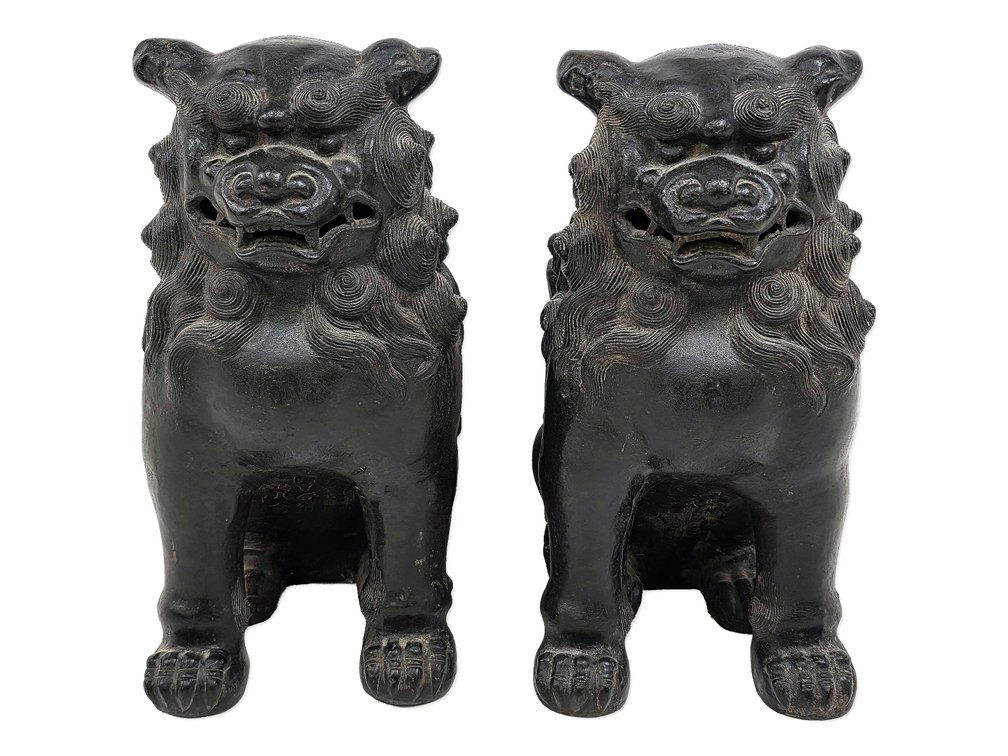
#212 • Pair of Chinese Bronze Guardian Lions, Republic Period
Part of Fall 2026 Premier Auction (live auction by Alaska Premier Auctions & Appraisals)
High bid $800.00
Status: SOLD
Category: Art
A substantial pair of Chinese hollow-cast bronze guardian lions dating to the Republic period, first half of the 20th century, most likely circa 1920–1940. Commonly known in the West as foo or fu dogs, the closely corresponding figures are modeled in seated poses with broad chests, powerful forelegs, and imposing proportions. Their protective iconography draws upon the longstanding Chinese tradition of guardian lions associated with the entrances of temples, palaces, official buildings, and important residences. Each lion is distinguished by a dramatically expressive face with protruding eyes beneath tightly spiraled brows, a broad flattened muzzle, flared nostrils, and a partially open mouth revealing teeth and a modeled tongue. Dense rows of deeply articulated spiral curls form the voluminous mane and continue across the neck, shoulders, and back. Long, finely incised locks descend over the chest, while the vigorously upswept tail terminates in layered, flame-like tufts. The comparatively smooth, swelling bodies provide a strong visual contrast to the concentrated concentric and linear treatment of the manes, brows, and tails. The two figures are closely corresponding rather than conventionally differentiated as male and female. Neither possesses the brocade ball or cub commonly used to identify the respective members of a traditional guardian-lion pair. They are therefore presented as complementary protective figures without assigning individual genders. The open underside of each bronze is incised with a multi-column inscription in archaistic Chinese bronze script, or jinwen, accompanied by a separate rectangular cartouche containing a pictorial emblem. The principal inscription closely follows the twenty-two-character dedication associated with the late Western Zhou ritual vessel known as the Man Gongfu Xu. The inscription may be translated approximately as: "Man Gongfu made this precious xu for sacrificial use and filial service in the ancestral temple, to seek longevity; may his sons and grandsons forever treasure and use it." Because the text expressly identifies the commissioned object as a xu, an ancient covered vessel used for ritual food offerings, its appearance on these guardian lions represents the deliberate quotation of an admired ancient bronze inscription. It is not a maker's signature, a dedication composed specifically for the lions, or evidence that the sculptures themselves date from the Western Zhou period. The appropriation of this ancient inscription places the bronzes within the broader Chinese fanggu, or "imitating antiquity," tradition. Through this longstanding antiquarian practice, the forms, ornament, and inscriptions of early ritual bronzes were studied and adapted for later works. Here, the borrowed inscription lends the guardian figures an appearance of historical authority and classical refinement characteristic of the renewed interest in ancient Chinese epigraphy that continued into the Republic period. The rectangular pictorial cartouches similarly recall the clan emblems and lineage devices encountered on Shang and early Western Zhou bronzes. Such emblems occupy a complex position between pictorial imagery and written language, and the precise reading of the devices on the present sculptures has not been established. They should not be interpreted as conventional maker’s seals or assigned a specific auspicious translation without additional epigraphic evidence. Both bronzes retain dark brown-black patination with wear commensurate with age. The undersides remain open and comparatively rough from manufacture. Each measures approximately 8" W × 10.5" D × 15" H. Auction Estimate: $800–$1,200.