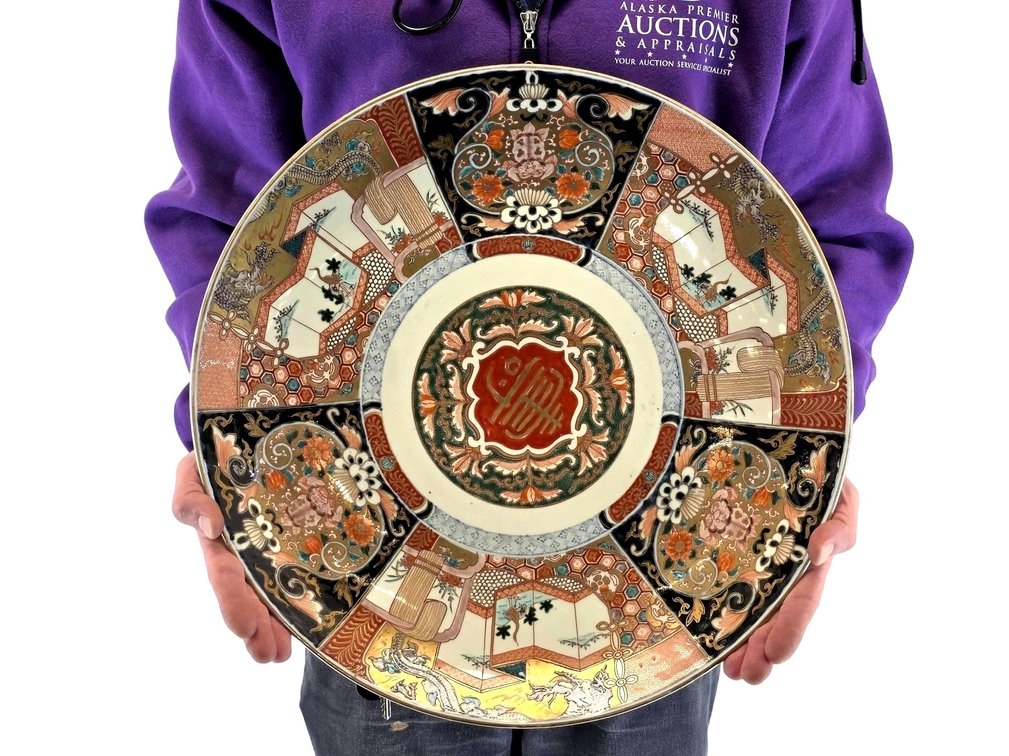
#142 • 18" Meiji Japanese Imari Dragon Porcelain Charger
Part of Fall 2026 Premier Auction (live auction by Alaska Premier Auctions & Appraisals)
High bid $225.00
Status: SOLD
Category: Ceramics
A large Japanese porcelain charger dating to the Meiji period (1868–1912), probably late 19th century, densely hand-painted in iron red, underglaze cobalt blue, green, turquoise, aubergine, black, and extensive gilt. Measuring approximately 18" in diameter, the charger combines dragon imagery, auspicious symbolism, and textile-derived ornament within a complex six-part composition. The center displays a prominent gilt longevity character, commonly read as shou in Chinese and kotobuki in Japanese—reserved against iron red and enclosed by a shaped white border. Dense green-and-gold foliate scrollwork surrounds the character, followed by an unusually broad undecorated white band and a narrow pale-blue diaper border. The deliberate use of open white space gives particular emphasis to the central wish for longevity. The outer field is divided into six alternating sections. Three black-ground panels are enriched with gilt scrolling foliage and shaped cartouches containing flowers and stylized auspicious objects. The intervening panels depict overlapping folding screens, draped textiles, flowering branches, and an array of geometric brocade patterns. Sinuous dragons wind through the gilt outer fields beside these panels, appearing among stylized clouds and wave-like ornament. Chrysanthemums, peonies, honeycomb patterns, floral scrolls, and repeated gilt details fill nearly every remaining surface. The dense juxtaposition of painted screens and textile patterns is particularly characteristic of elaborate Japanese Imari decoration, in which motifs derived from costly woven fabrics were translated into porcelain. The dragons convey power and vitality, while the chrysanthemums and centrally placed longevity character reinforce the charger’s auspicious character. The reverse is also extensively decorated, with black scrolling vines enlivened by turquoise and iron-red details, alternating with large iron-red and gilt chrysanthemum heads. Concentric underglaze-blue lines define the foot and surrounding borders. The recessed underside bears an underglaze-blue six-character mark reading Da Ming Chenghua nian zhi, or “Made during the Chenghua reign of the Great Ming.” The mark is apocryphal and should be understood as an archaizing tribute mark; it does not indicate manufacture during the 15th-century Chenghua reign. A later black inventory inscription, “#137,” also appears beneath the foot. Wear commensurate with age, with possible minor firing irregularities. Measures approximately 18" diameter x 2.5" H. Auction Estimate: $400–$600.