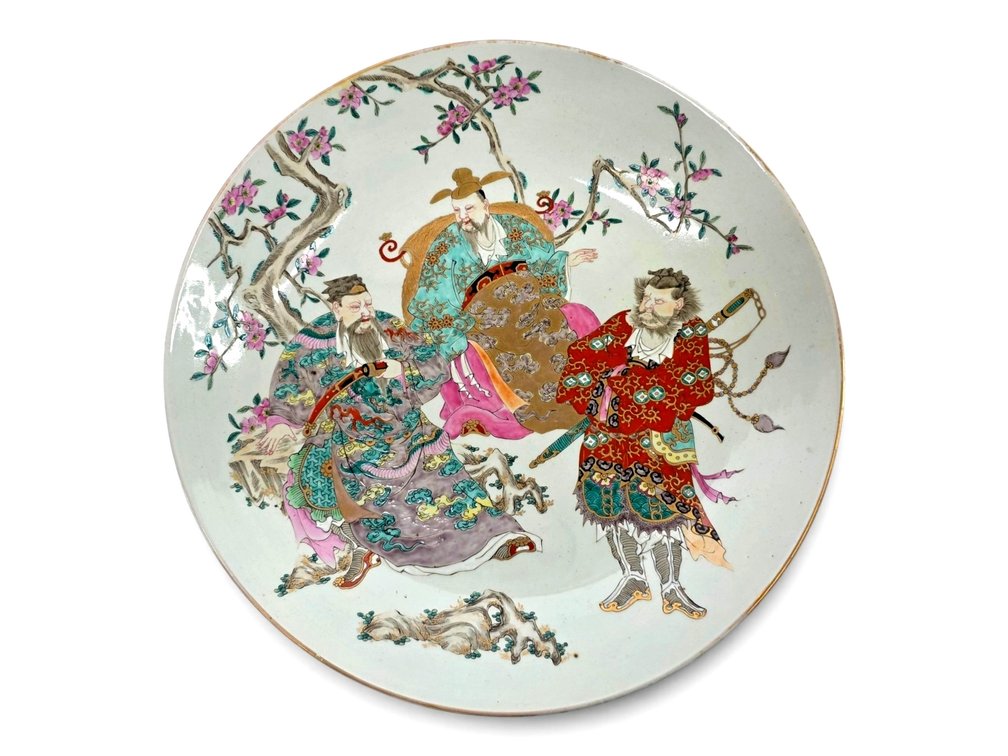
#146 • 19" Japanese Hichozan Shinpo Arita Porcelain Charger
Part of Fall 2026 Premier Auction (live auction by Alaska Premier Auctions & Appraisals)
High bid $425.00
Status: SOLD
Category: Ceramics
A large, finely painted Japanese Arita porcelain charger, dating to the late Edo or early Meiji period, circa 1860–1880, and depicting Liu Bei, Guan Yu, and Zhang Fei beneath the flowering branches of a peach tree. The composition represents the celebrated Oath of the Peach Garden episode from the fourteenth-century Chinese historical novel Romance of the Three Kingdoms. Liu Bei occupies the center, seated in the elevated position of a ruler and wearing an elaborately patterned turquoise robe above a brown-and-gold apron decorated with cloud forms. At left, Guan Yu is distinguished by his exceptionally long beard and dignified bearing, while Zhang Fei stands at right with a bristling beard, animated expression, and richly patterned iron-red garments. Both warriors are represented with swords, emphasizing their martial identities. The meticulously rendered costumes incorporate cloud scrolls, floral ornament, geometric borders, auspicious roundels, and gilt detailing, while the faces, hair, hands, and layered textiles display remarkably precise brushwork. Gnarled peach branches laden with pink blossoms extend across the upper field, framing the three figures against a pale bluish-white ground. Carefully painted rockwork anchors the composition below. The extensive open ground provides an effective visual counterpoint to the intricately decorated garments, giving the figures unusual clarity and monumentality while allowing the expansive porcelain surface to function almost as a painted narrative composition. According to the literary narrative, Liu Bei, Guan Yu, and Zhang Fei gathered in a peach garden and pledged themselves as sworn brothers, united by loyalty and their determination to restore order during the declining years of the Eastern Han dynasty. Although the formal peach-garden oath is a literary episode rather than a securely documented historical event, it became one of East Asia’s most enduring emblems of brotherhood, fidelity, courage, and righteousness. The story enjoyed widespread popularity in Japan from the Edo period onward and appeared across painting, woodblock prints, metalwork, and ceramics. The reverse is decorated with a continuous flowering vine rendered in underglaze cobalt blue, iron-red enamel, and gilt, enclosed by concentric blue borders. Within the foot is a six-character iron-red mark reading Hichōzan Shinpō sei, translated as “Made by Hichōzan Shinpō.” Hichōzan Shinpō was a commercial name employed by the prominent Arita porcelain merchant Tashiro Monzaemon during the late Edo and Meiji periods. The concern produced and marketed finely decorated porcelain, much of it intended for export. The Hichōzan Shinpō inscription is consequently a meaningful period maker’s mark associated with nineteenth-century Japanese porcelain production rather than a decorative or apocryphal inscription. The mark, painting style, porcelain body, and reverse decoration collectively support a late Edo to early Meiji attribution, approximately 1860–1880. Some gilding loss to the rim and wear commensurate with age. Measures approximately 19" in diameter x 2.75" H. Auction Estimate: $800–$1,200.