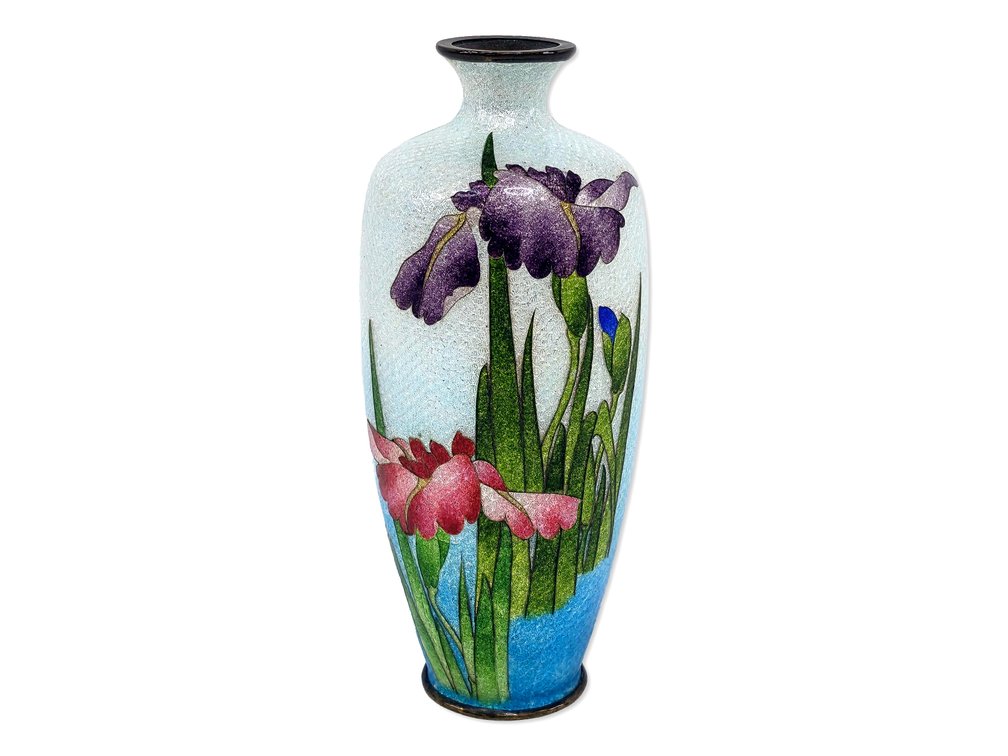
#208 • Meiji–Taisho Japanese Ginbari Cloisonné Iris Vase
Part of Fall 2026 Premier Auction (live auction by Alaska Premier Auctions & Appraisals)
High bid $325.00
Status: SOLD
Category: Decorative Objects
A Japanese ginbari cloisonné vase of the late Meiji to Taisho period, circa 1900–1925, decorated with flowering irises against a luminous ground shading from turquoise blue at the foot to pale, silvery blue at the shoulder. The elongated body narrows toward the base and rises through rounded shoulders to a short, flared neck. Slender copper-alloy mounts frame the mouth and foot. Purple and rose-pink blossoms extend across the front, their broad, drooping petals accented with yellow markings. Slender stems, unopened buds, and overlapping, sword-shaped leaves carry the composition upward around the vessel. Fine outlines articulate the flowers and foliage, while the largely undecorated reverse reveals the graduated color and delicate texture beneath the enamel. The shimmering surface is characteristic of ginbari, a technique employing embossed silver foil beneath translucent enamel. A finely patterned foil ground catches the light through the blue, lending depth and brilliance to the surface. Its repeating texture remains visible through the paler passages, providing a subtle ornamental setting for the more freely arranged flowers. Irises have a distinguished place in Japanese decorative painting, where their expansive petals and upright leaves offer a striking interplay of curved and linear forms. Here, that contrast is particularly effective against the softly graduated background, with the clustered blossoms balanced by open areas of luminous enamel. The underside has concentric rings and an indistinct central impression that does not permit a secure maker attribution. A few minor scattered dark spots are present in the enamel on the body, with other wear commensurate with age, including rubbing to the metal base. The vase measures approximately 7.5" high × 3" in diameter. Auction Estimate: $300–$500.