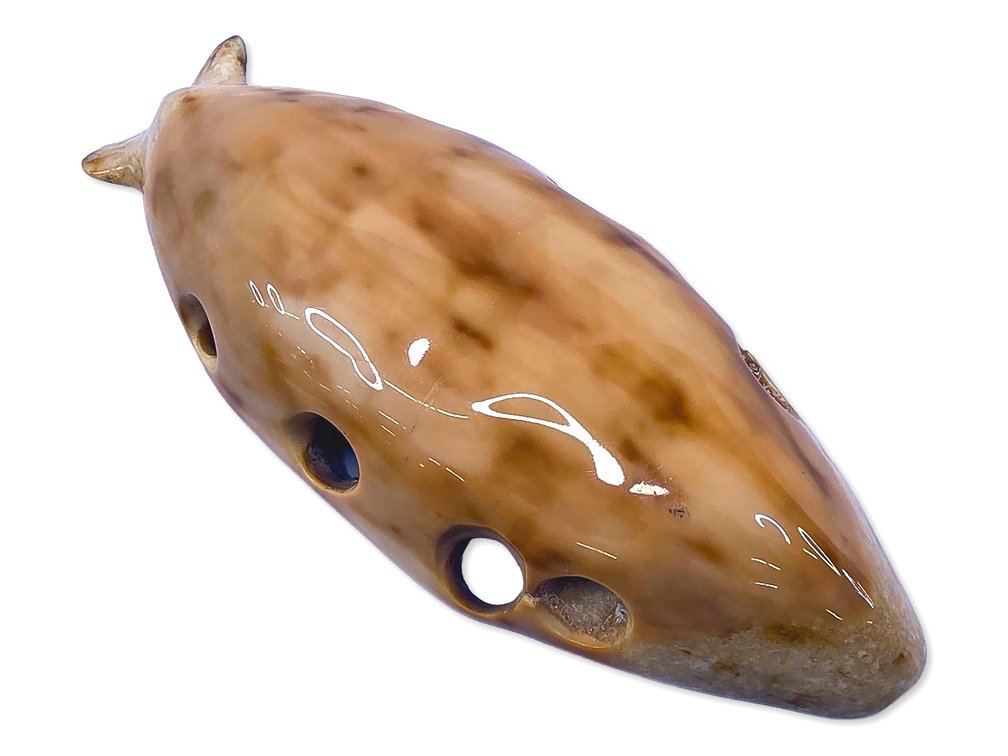
#237 • Large Punuk or Thule Eskimo Whale Effigy Artifact
Part of Fall 2026 Premier Auction (live auction by Alaska Premier Auctions & Appraisals)
High bid $600.00
Status: SOLD
Category: Artifacts
A substantial Alaskan Eskimo whale effigy carved from ancient mineralized walrus tusk, of the Punuk or Thule tradition. Punuk is generally dated circa AD 800–1400; Thule followed and overlapped it, with regional chronologies varying. Measuring more than six inches long, the carving has a broad, solidly modeled body and considerable sculptural presence. Possibly a hunting charm or an ornament attached to equipment, it conveys the whale through a rounded head, arching back and short tail stock spreading into horizontal flukes. Cream and honey-colored tusk, mottled with deeper brown passages, lends warmth and visual depth to its generous proportions. Three substantial perforations along each lower flank distinguish the carving. Their placement around the margins of a recessed underside suggests an arrangement for lashing or fastening the whale against a supporting surface. Shallow circular depressions appear near the head, while the underside retains rough, irregular material contrasting with the smoothly polished back. The combination of substantial scale, recognizable animal form and multiple attachment points gives the piece interest as both a sculptural object and a possible component of a larger functional or ceremonial assembly. Its original mounting and precise purpose remain unconfirmed. The Thule tradition developed along coastal Alaska and spread eastward across the Arctic. The Metropolitan Museum of Art’s broad chronology places Thule cultures around AD 1000–1850, although regional chronologies vary. These communities were accomplished maritime hunters, taking whales, walruses and seals with sophisticated equipment and accumulated knowledge of sea ice, animal movements and coastal waters. The University of Alaska Museum of the North emphasizes their adaptation to hunting very large marine mammals in open water, using harpoon lines equipped with drag floats. This intensive maritime way of life provides a meaningful setting for whale imagery, without implying that earlier Arctic cultures lacked marine hunting traditions. A particularly relevant functional comparison appears in Penn Museum’s study, “An Eskimo Whaling Outfit from Sledge Island, Alaska,” by Susan A. Kaplan, Richard H. Jordan and Glenn W. Sheehan. The authors document wooden boards bearing raised whale carvings that served as charms tied to an umiak’s frame. Their account illustrates how animal imagery, spiritual preparation and practical equipment could be closely intertwined. Although those wooden examples differ in material and construction, they provide a documented precedent for considering the present whale a possible hunting charm or attached ornament. Condition includes surface scratches, pits, fine checking, irregular lower edges and wear or small losses at the flukes. Some margins surrounding the perforations are thin. The upper surface is quite polished; it is unknown whether this is due to natural oceanic weathering or a later intentional polish. Measures approximately 6.25 inches long × 2.5 inches wide × 1.5 inches high. Auction Estimate: $800–$1,200.