#260 • Florence Nupok Malewotkuk — Two Polar Bear Hunting Pen-and-Ink Drawings
Part of Fall 2026 Premier Auction (live auction by Alaska Premier Auctions & Appraisals)
High bid $900.00
Status: SOLD
Category: Art
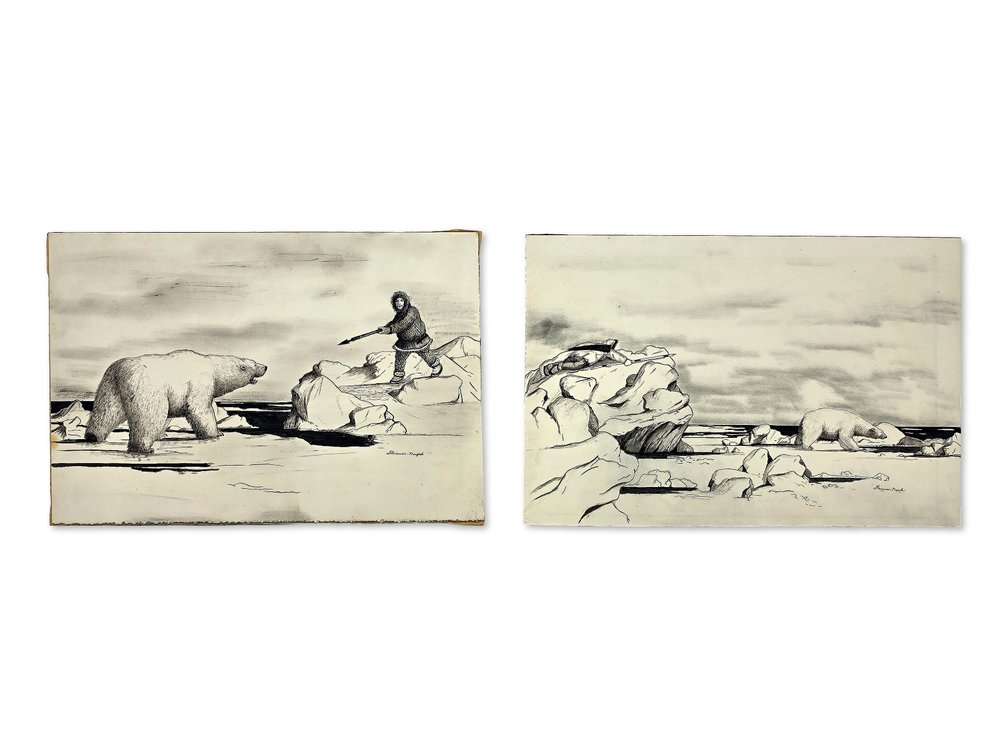
Two dramatic pen-and-ink drawings with tonal shading on paper by Siberian Yupik artist Florence Nupok Malewotkuk (1906–1971) of Sivuqaq/Gambell, St. Lawrence Island. Collection cards identify the works as Duel on Ice and The Hunted Hunter. In Duel on Ice, a hooded hunter directs a long spear toward an open-mouthed polar bear across a dark channel. The spear draws the eye between the opposing figures, while broken ice emphasizes the uncertain footing around them. Fine strokes distinguish the bear’s fur and the hunter’s clothing against the angular landscape. The Hunted Hunter changes the balance of the encounter. A man lies prone on a high ledge while a bear moves below beside the water. The height of the ice and the hunter’s low position replace the first scene’s open confrontation with a more watchful suspense. Florence leaves the outcome of both encounters unresolved, giving the viewer time to consider the gestures and the ground separating human and animal. The subjects reflect the hunting life and stories of her island community, rendered with a strong sense of narrative and place. Both works are signed “Florence Nupok” at lower right. Florence began drawing as a child and developed a professional career despite limited access to materials and the barriers faced by Native women artists of her generation. In 1927–28, archaeologist Otto William Geist commissioned more than ninety drawings documenting island life, preserving an unusually extensive record made by an artist within the community itself. Her work is held by the University of Alaska Fairbanks, the Anchorage Museum, the Smithsonian’s National Museum of the American Indian and the California Academy of Sciences. Offered unframed on board, with Crescent illustration-board marks, brown marginal tape and “Karl R. Reinhard” inscriptions on the reverses. Both have toning and edge wear. Duel on Ice has pronounced browning and abrasion along the lower edge and a rectangular discolored area near the lower margin; The Hunted Hunter has scattered small brown spots. The larger work measures approximately 10.25 × 15 inches. Provenance: Acquired directly from the artist by Karl R. Reinhard, D.V.M., Ph.D., during his field visits to St. Lawrence Island between 1954 and 1960; then by descent. A veterinarian and microbiologist whose field career extended from New Guinea to Alaska, Reinhard served with the United States Public Health Service beginning in 1951. During these health-study visits, he developed lasting friendships with residents of Gambell and Savoonga and assembled a collection of Indigenous artwork and historic objects. He remembered these years as the “golden period” of his career and later drew upon them for People of the Squeezed-Out Land: The Art and Times of an Eskimo Artist, an unpublished manuscript preserved in an annotated April 1975 draft. According to information provided by Reinhard’s family, the collection was exhibited at the University of Nebraska State Museum in Lincoln, Nebraska, in 1993–94. Artist–Collector Provenance: Karl R. Reinhard’s relationship with Florence Nupok Malewotkuk extended beyond the purchase of her drawings. He visited her home, corresponded with her and helped arrange access to the materials she needed to work. His manuscript preserves her voice alongside his recollections, providing a personal account of an artist whose drawings recorded the people, animals and traditions of her island homeland. One exchange captures the urgency she felt about her work. Asking him to arrange drawing supplies, Florence declared, “I must always be drawing—drawing!” Reinhard described her use of pen and ink with graphite or charcoal for shading, and her preference for carefully prepared, bleached sealskin. As suitable skin became scarce, she increasingly relied on friends from the mainland to obtain paper and drawing supplies. Her choice of materials thus reflects both artistic preference and the practical realities of working in an isolated island community. Reinhard remembered a vivacious woman who laughed easily, including at herself, and took pride in presenting her people and their way of life. Drawing also helped support her household. In an April 1955 letter, she described servicemen arriving each evening seeking pictures, sometimes bringing photographs of wives, girlfriends, mothers and children for her to reproduce on skin. These commissions reveal a broader working practice than her familiar Arctic subjects alone suggest. During his visits, Florence’s household still used a traditional seal-oil lamp for heat and light. Reinhard believed that much of her early work had been drawn by the light of its double line of flame. His account places her artistic practice within the domestic world she knew and depicted, while their correspondence preserves the resourcefulness, humor and determination behind it. Auction Estimate: $800–$1,200.