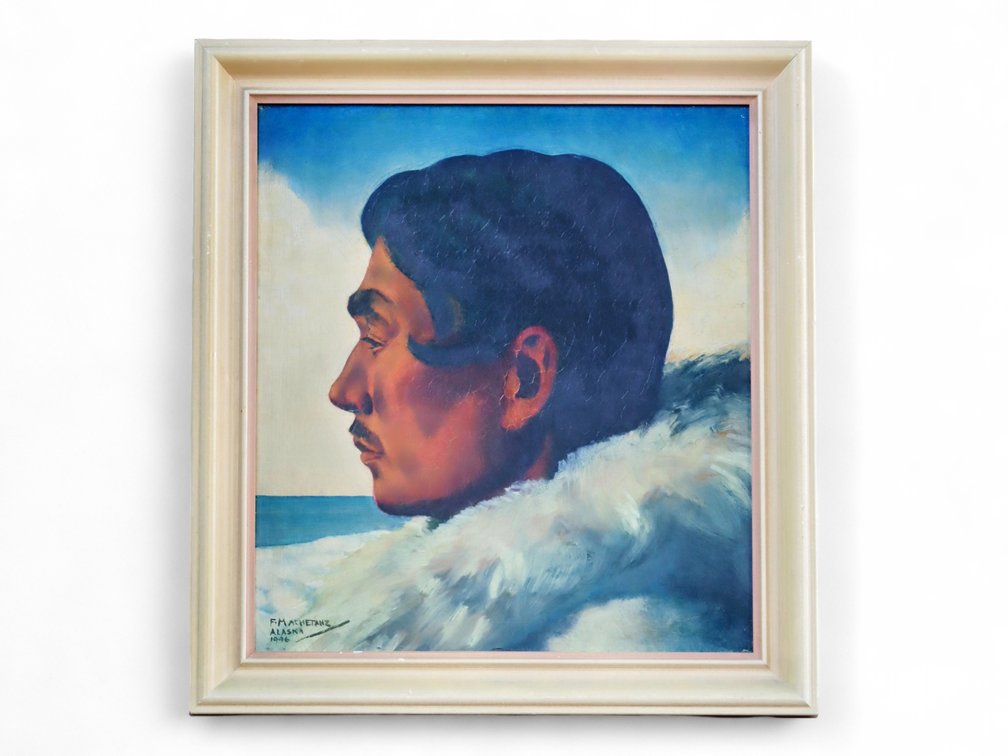
#25 • Important 1946 Fred Machetanz “Accibuck” Oil on Masonite
Part of Fall 2026 Premier Auction (live auction by Alaska Premier Auctions & Appraisals)
High bid $10,750.00
Status: Sold
An important early oil on Masonite by Fred Machetanz (1908–2002), this portrait of Accibuck dates to 1946, the year of the artist’s postwar return to Alaska. The warm complexion, dark hair, enveloping white fur and cool blue surroundings establish a compelling relationship between the sitter and his northern environment. Believed to be the original color oil study for Accibuk the Seal Hunter, the first of Machetanz’s fifty stone lithographs, the painting brings together a personally significant subject and a formative moment in the artist’s career. Accibuck was a friend, knowledgeable hunter and storyteller whom Machetanz met during his earliest years in Alaska. Their relationship began during the artist’s first extended stay in Unalakleet, where he arrived in 1935 to visit his uncle, trading-post proprietor Charles Traeger. Recently trained in art at Ohio State University, Machetanz intended to remain for six weeks; the visit stretched to two years. Hunting, dog teams, coastal travel and the daily lives of the people around him became the subjects of his sketchbooks and the foundation of his enduring attachment to Alaska. The exchange of an early charcoal portrait for Accibuck’s hunting knife illustrates the personal relationship behind these images. A related drawing dated May 20, 1936, records the sitter during that first extended visit. The present painting returns to his likeness a decade later, after Machetanz had established himself as an illustrator and served in the wartime North Pacific. When Machetanz left Unalakleet in 1937, he took a portfolio of Alaskan paintings and drawings to New York, hoping to illustrate books about the territory. Publishers admired his work but had no suitable projects available, encouraging him to write the books himself. The result was Panuck, Eskimo Sled Dog in 1939, followed by On Arctic Ice in 1940. His observations of Alaska were becoming the basis of a professional career combining pictures and storytelling. During World War II, Machetanz served in the Aleutians from 1942 to 1945, rising to lieutenant commander with responsibility for intelligence for the North Pacific Command. Following his discharge, he studied lithography with Will Barnet at the Art Students League in New York before returning to Unalakleet. The present portrait belongs to that transition, bringing a familiar subject from his first Alaska years into the opening chapter of his postwar work. Its closely corresponding composition, reversed in the printed image of Accibuk the Seal Hunter, supports the proposed relationship between painting and lithograph. The distinction is especially meaningful because the print opened a series of fifty stone lithographs produced between 1946 and 1980. Working on limestone, Machetanz translated northern faces, clothing, wildlife and landscapes into carefully organized passages of light and dark. The stones were sent to a specialist printer in New York, and complete sets of the resulting works entered museum collections, including the Frye Art Museum. As an early oil painting, the portrait also offers an opportunity to consider the development of Machetanz’s distinctive color relationships and painting technique. Influenced by Maxfield Parrish, he became celebrated for transparent glazes built over an underpainting, characteristically employing ultramarine to establish form and tonal depth. Successive layers produced the luminous surfaces associated with his mature work. Here, the interplay of warm flesh, white fur and surrounding blue anticipates a vocabulary he would refine over the following decades. Machetanz met Sara Dunn during his return journey to Alaska and married her in Unalakleet in 1947. Their subsequent life together encompassed books, films, lectures and painting, while the successful 1962 Anchorage exhibition finally enabled him to devote himself to painting full time. This portrait predates that breakthrough by sixteen years. Its early date, personal subject and believed association with his first stone lithograph give it particular significance within the development of one of Alaska’s most recognized artists. Measures approximately 20 × 16 inches image sight; 21.5 × 19.75 inches framed. Auction Estimate: $15,000–$20,000.